
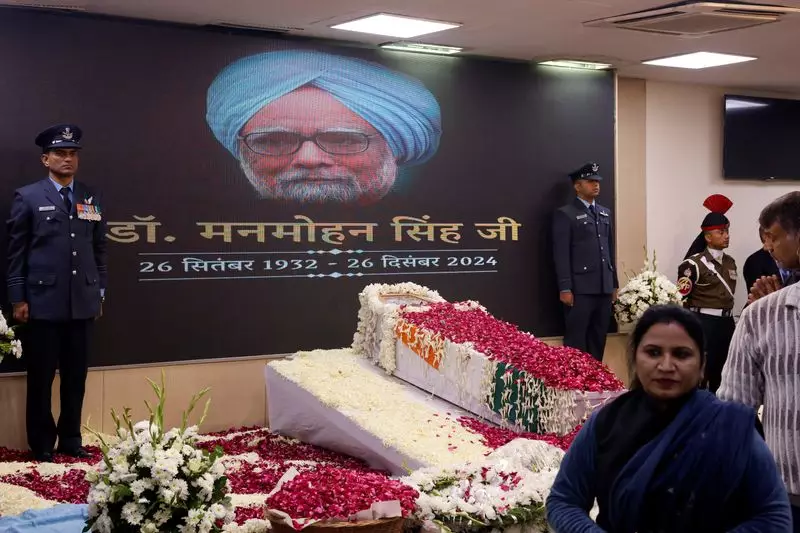
The recent passing of Manmohan Singh, a former Prime Minister of India, has evoked profound sorrow across the nation and resonated internationally. On Sunday, his cremation took place on the serene banks of the Yamuna River in New Delhi, enveloped in the dignified rituals befitting a leader of his stature. Thousands gathered to pay tribute as his body, draped in the Indian flag and surrounded by a floral array, was transported through the streets on a ceremonial army truck. The ritual was steeped in tradition; Sikh priests recited hymns as Singh’s family and esteemed guests, including Prime Minister Narendra Modi and President Droupadi Murmu, observed the solemnity of the occasion. The body was eventually covered in a saffron cloth before being placed upon the pyre, marking the revered leader’s final departure from the mortal realm.
Throughout his tenure as Prime Minister from 2004 to 2014, Singh was known for his pivotal role in steering India toward economic liberalization. Despite facing domestic challenges, including accusations of ineffective governance and corruption within his coalition government, Singh’s economic policies laid a foundation for growth that future leaders would build upon. His statement, “history will be kinder to me than the contemporary media,” has gained renewed attention in the wake of his death, underscoring the complexities of nationalist narratives and historical legacy. Singh’s tenure witnessed economic transformations that garnered both praise and criticism, particularly in light of the contrasting economic philosophies propagated by his successor, Prime Minister Modi.
Singh’s death has sparked a wave of condolences from several global leaders, highlighting his contributions on the international stage. Messages from the leaders of countries such as the United States, Canada, France, Sri Lanka, China, and Pakistan echoed sentiments of respect and recognition for his diplomatic acumen. Notably, Singh had been a key figure in promoting India’s role as a responsible global power. His emphasis on progressive foreign policies built bridges that fostered goodwill towards India and initiated numerous cooperative agreements across various sectors.
Leaving behind a legacy that transcends politics, Singh is remembered not only as a statesman but also as a family man, survived by his wife and three daughters. His life was marked by a humility that resonated with the public, making him a beloved figure in India’s political landscape. As his family led the procession to the Nigambodh Ghat cremation site, joined by Congress party leaders and supporters, it became evident how deeply Singh’s life and work impacted countless individuals. The Indian government has announced land allocation for constructing a memorial in his honor, a fitting tribute to a leader who indelibly shaped modern India.
In sum, Manmohan Singh’s death marks the end of an era. His legacy as a visionary leader and an economic reformer, tempered by personal humility, offers a multitude of lessons for future generations. The outpouring of grief and appreciation for his contributions serves as a testament to the complex and enduring influence he has had on both India and the global community.