
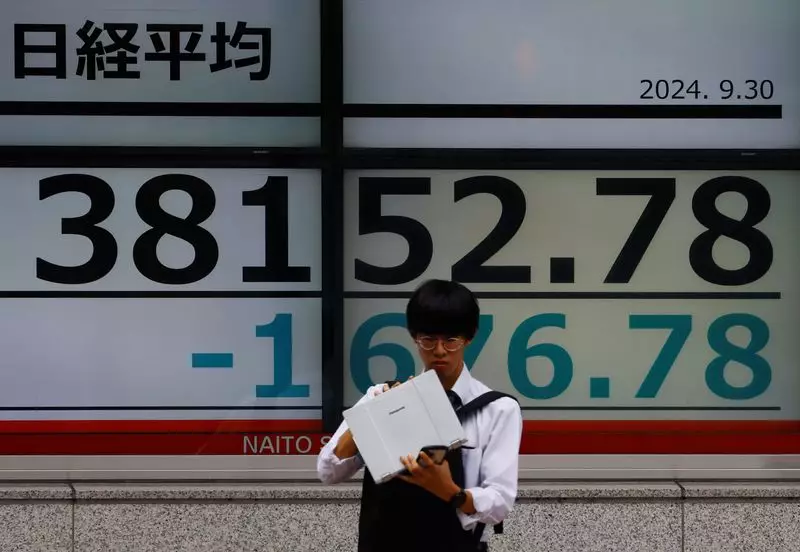
On a promising Monday, Asian stock markets demonstrated a notable rally in response to a soothing report on U.S. inflation, which has rekindled optimism regarding potential policy easing in the forthcoming year. This sentiment was further bolstered by the news that the U.S. government averted a shutdown, alleviating immediate fiscal concerns and fostering a favorable trading environment. The Asian market’s positive momentum signals a collective sigh of relief as investors digest these developments, reinforcing the correlation between U.S. economic health and regional market performances.
The aftershock of well-synchronized central bank policies has dominated financial discussions recently, but this week is characterized by a relative lull. With few central bank meeting minutes yet to be revealed and no scheduled speeches from Federal Reserve officials, the market’s focus shifted primarily to the outgoing effects of last week’s data. The prevailing narrative aligns with a dollar strength supported by a resilient economy, which in turn raises challenges for commodities, including gold and oil, as well as for emerging markets that may face currency instability.
The robust performance of the dollar has created significant hurdles for emerging market economies. As these nations struggle to manage currency depreciation, the need for intervention becomes paramount. Failure to address this volatility could trigger further inflationary pressures, compounding pre-existing economic challenges. Observers noted a 0.3% rise in the MSCI Asia-Pacific index, establishing renewed bullishness among investors, particularly as Japan’s Nikkei and South Korea also showed commendable gains of 0.7% and 0.9%, respectively.
However, the broader implications of dollar strength cannot be overlooked. Currency fluctuations and high bond yields detrimentally affect external purchasing power, which could reduce demand for imported goods and accelerate inflationary trends domestically. Consequently, emerging economies must tread carefully in navigating this turbulent financial landscape while trying to sustain growth.
The critical economic indicators emerging from the United States painted a mixed picture. Recent reports disclosed that the core inflation metric had printed lower than anticipated, registering only a modest 0.11% increase. This result has served as a counterbalance to the Federal Reserve’s previously hawkish stance. Market sentiment reflected a complex interplay, with traders adjusting their rate cut expectations based on the new data. For instance, current predictions place a 53% probability on a rate cut by March and a 62% likelihood by May, a shift from previous anticipations of deeper cuts.
Yet, caution remains as analysts from Bank of America have voiced concerns over the concentration of gains within a handful of companies comprising the S&P 500. Their data points toward a disconcerting reality: if these top performers were excluded, the index’s year-to-date performance would reveal a modest gain of merely 8%. The heavy reliance on a small group of stocks raises red flags for future stability, particularly as the market heads into 2025.
Bond markets have experienced significant fluctuations in response to the evolving economic landscape. The prevailing environment forced 10-year Treasury yields up nearly 42 basis points in the span of two weeks, marking the steepest ascent since April 2022. Investor anxieties about inflation pressures compounded by escalating tariff threats and tightening labor markets have led to an unsettling forecast for both inflation and employment figures. Economists at JPMorgan have suggested the likelihood of three-quarter point cuts in the upcoming year, though they remain skeptical about immediate easing.
In the commodities sphere, the rallying dollar and rising yields have put downward pressure on gold and oil prices. The yellow metal, currently hovering around $2,624 an ounce, faced a downturn of approximately 1% over the previous week. Oil prices, too, are caught in a quandary, hindered by disappointing Chinese demand figures. Brent crude and U.S. crude displayed minor gains, indicating that while the markets are stabilizing, substantial headwinds remain.
The current economic and market environment encapsulates an intriguing chapter in global finance, defined by the delicate balance between inflation data, central bank policies, and the interconnectedness of international markets. As stakeholders navigate these complexities, the outlook remains teetering between cautious optimism and underlying vulnerabilities. The coming weeks will be crucial in determining whether the recent rally is sustainable or if emerging challenges will overshadow the initial gains. Investors must remain vigilant, ensuring that they are prepared for a potentially volatile economic backdrop ahead.