
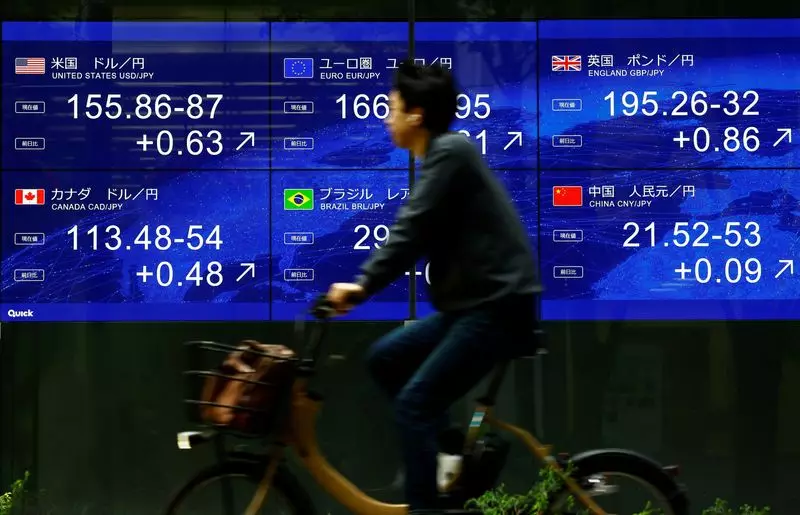
Asian markets opened the week with a sense of cautiousness as traders grappled with the implications of elevated Treasury yields. High interest rates in the U.S. are igniting debates surrounding the viability of current equity valuations on Wall Street. This context underpins a robust U.S. dollar, which has reached multi-month highs, creating a challenging landscape for investors in the region. Trading volumes are notably subdued, attributed partly to the approaching New Year holiday, coupled with a sparse economic data schedule this week.
On the horizon, significant data releases include China’s Purchasing Managers’ Index (PMI) for manufacturing on Tuesday and the U.S. ISM survey for December, expected Friday. These reports hold the potential to reshape market perspectives, depending on their outcomes. Currently, the MSCI Asia-Pacific index, excluding Japan, showed a modest dip of 0.2% but remains buoyed by a remarkable 16% increase year-to-date. Meanwhile, Japan’s Nikkei index experienced a 0.9% reduction yet boasts an impressive rise of approximately 20% for 2024, indicating a mixed response from investors navigating volatile conditions.
The South Korean market stands in stark contrast to its Asian counterparts, grappling with political turbulence that has resulted in a steeper decline of around 9% this year. Despite a recent 0.3% uptick, the specter of instability looms large over investor sentiment. Notably, Jeju Air, a low-cost airline in South Korea, is facing dire repercussions on its stock following a tragic plane crash that resulted in 179 fatalities, marking a record low for the company’s shares.
Investor confidence is further tested, influenced by ongoing political uncertainties that hinder potential market recovery. This scenario underscores the delicate interplay between politics and economic performance, highlighting the challenges for investors in such turbulent waters.
In the U.S., Wall Street recently endured a broad exit from equities, with no clear catalyst for the sell-off. While the S&P 500 and Nasdaq remain strong year-to-date, up 25% and 31% respectively, rising Treasury yields continue challenging the sustainability of these valuations. Analysts note that the increase in 10-year Treasury yields—hovering around 4.631%, marking an eight-month peak—suggests investor concerns regarding future corporate earnings growth.
Traders are closely monitoring expected earnings growth, which is projected just over 10% for 2025, and notably lower than the anticipated growth rate of 12.47% for 2024. Such figures amplify concerns regarding the Federal Reserve’s direction on monetary policy and whether it may maintain tighter conditions longer than anticipated, potentially stunting earnings momentum.
The U.S. dollar’s strength is an essential aspect of the current landscape, largely driven by widening interest rate differentials compared to other currencies. The dollar has surged 6.5% year-to-date against a basket of major currencies. Conversely, the euro has depreciated over 5%, currently trading at approximately $1.0427, edging close to its two-year low. This strong dollar position creates obstacles for commodities and emerging markets heavily reliant on a weaker dollar.
The pressure extends to gold, typically a safe haven when market conditions worsen, yet it remains 28% higher for the year, trading around $2,624 per ounce. Meanwhile, oil prices, particularly Brent crude, face headwinds as demand concerns—especially about China—persist. Brent crude settled at $74.23 per barrel, while U.S. crude lingered at $70.61, reflecting ongoing apprehensions about supply and demand dynamics.
Asian markets are treading carefully as they contend with external economic pressures marked by high U.S. Treasury yields, a resilient dollar, and political uncertainties—especially glaring in South Korea. As we look ahead, the forthcoming economic data from both China and the U.S. could either reaffirm prevailing trends or trigger a recalibration among investors. The interplay of these factors underlines the necessity for heightened awareness and adaptability in investment strategies amid a complex and evolving global economic landscape.