
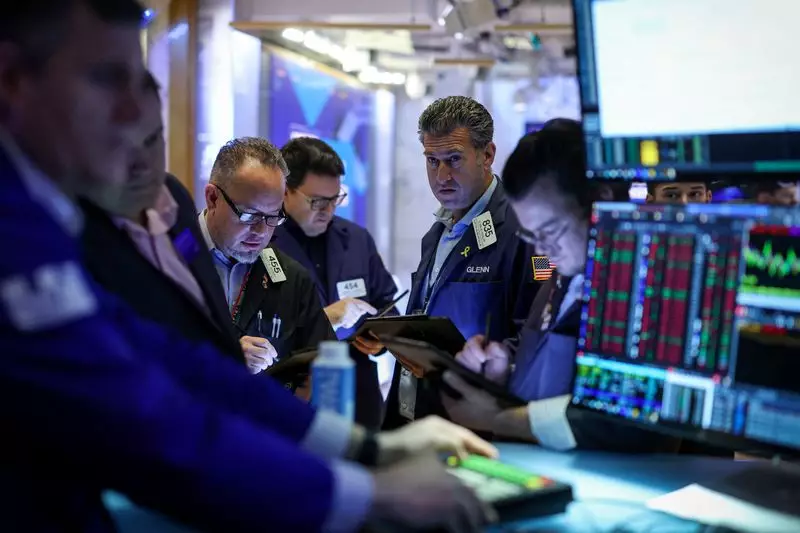
Financial markets are experiencing a whirlwind of activity as various economic indicators sway investor sentiment in unpredictable directions. The recent data surrounding inflation, alongside the Federal Reserve’s cautious approach to interest rates, has spurred anxiety among traders and analysts alike. Wall Street’s fluctuations are now driven by a complex interplay between economic growth expectations and inflationary pressures, prompting critical discussions that could shape the future landscape of investments.
Inflation Data: A Silver Lining Amidst Uncertainty
On the frontier of this financial turbulence is the Personal Consumption Expenditures (PCE) index, which is closely watched by the Federal Reserve. The November report revealed a modest inflation rise of 2.4% year-on-year, slightly below the analysts’ forecast of 2.5%. This lower-than-anticipated figure provided a momentary relief to investors, allowing stock index futures to recover slightly from initial drops. However, the overarching sentiment remains ominous as traders brace for potential high interest rates in the forthcoming year, a concern that continues to loom over market dynamics.
As a response to the cooling inflation, traders have started adjusting their predictions regarding future interest rate cuts, anticipating the first one could arrive as early as March 2025. Surprisingly, this proactive adjustment signals optimism that broader economic conditions may favor rate reductions sooner than originally expected. Yet, the Fed’s recent stance, which indicated a conservative approach amid persistent inflation, suggests that the journey to economic balance is fraught with uncertainties.
The Federal Reserve’s measured projection regarding rate reductions has shaken Wall Street, where markets are still reeling from the unexpected duality of high inflation and a resilient labor market. This week, the Fed’s forecast hinted at just two cuts throughout 2025, prompting analysts like Mike Dickson to highlight the delicate equilibrium that exists between sustaining employment and curtailing inflation. The nuanced conversations about future economic policies suggest that both caution and readiness are required in navigating these turbulent waters.
Moreover, remarks from San Francisco Federal Reserve Bank President, Mary Daly, further emphasize a ‘wait and see’ approach. By labeling the decision to lower interest rates as a “close call,” this reinforces the notion that even incremental adjustments are significant. If the Fed indicates vigilance, it puts pressure on investors to reassess their strategies as economic indicators evolve.
Amid the backdrop of fluctuating markets and a cautious Fed, political tensions in Congress are adding another layer of complexity. With a looming deadline for averting a partial government shutdown, overall uncertainty surrounding fiscal policy intensifies. Over three dozen Republicans’ resistance to President-elect Donald Trump’s proposal to supplement the debt ceiling complicates negotiations, creating fears that a shutdown could further impede economic progress.
Experts, such as Wells Fargo’s Paul Christopher, forecast a new spending bill may not materialize in time to prevent a shutdown, anticipating fiscal measures to be pushed until the close of the year. This precarious situation adds to existing market volatility, suggesting that political hurdles could potentially derail economic recovery initiatives.
Pessimism regarding short-term performance is palpable, as evidenced by projections indicating the Nasdaq’s potential end to a five-week winning streak and the S&P 500 heading towards its most challenging week since September. Major tech players, including Tesla, Nvidia, and Amazon, are suffering from premarket losses of approximately 1%, which signifies a broader impact across the sector. Similarly, Nike’s revised revenue outlook has triggered a drastic 5% decline in its stock.
In contrast, certain companies posted impressive gains amidst the chaos. FedEx, buoyed by the announcement of its freight trucking division’s spinoff, surged 8.2% as the company seeks to streamline operations. Eli Lilly’s stock also enjoyed a 6.4% increase following news of a less-than-optimal trial involving a rival’s obesity drug, indicating that individual stock performance can diverge significantly from broader market trends.
The current market conditions evoke caution among investors, who must navigate the uncertain terrain dictated by fluctuating inflation data, Federal Reserve policies, and the ever-present political pressures in Washington. With divergent performances among individual stocks against a backdrop of uncertainty, the future trajectory of the markets remains undetermined. Investors must remain vigilant and adaptable, prepared for rapid changes influenced by the delicate balance between growth, inflation, and comprehensive economic health. The upcoming months will be pivotal in determining whether the market can stabilize or whether additional turbulence lies ahead.