
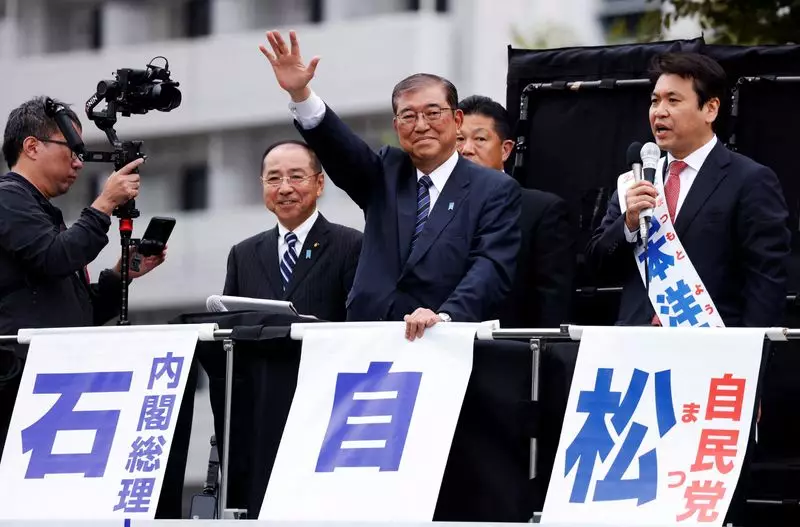
The political landscape of Japan is on the verge of a significant transformation as the results of a recent general election reveal that Prime Minister Shigeru Ishiba’s ruling coalition is likely to lose its parliamentary majority. This shift, driven by widespread public discontent over financial scandals and rising living costs, opens the door for considerable political maneuvering among various parties looking to either form a new government or assert their influence in a hung parliament.
The Liberal Democratic Party (LDP) has been the dominant force in Japanese politics since the post-World War II era, creating a legacy that has rarely faced serious competition. However, exit polls indicate a stark decline from the 247 seats they held, with projections suggesting they may secure anywhere between 153 and 219 seats—far below the 233 needed for a majority in the lower house. This decline can be attributed largely to a political funding scandal that has plagued the party, igniting voter frustration. Despite promises to rectify their financial practices, the LDP fielded numerous lawmakers who failed to report political donations that are essential to maintaining transparency and trust.
Concurrently, growing inflation and economic pressures have fueled dissatisfaction among voters, compelling many to reconsider their allegiance to the LDP. The party’s strategy of hastily calling an election following the resignation of former Prime Minister Fumio Kishida, ostensibly to distance themselves from the scandal, has not been well-received, potentially encapsulating the party’s struggles in the shifting tides of public opinion.
The Komeito party, the LDP’s long-standing coalition partner, has played a pivotal role in maintaining the LDP’s grip on power over the last two decades. Founded on principles of Buddhism and social welfare, Komeito has traditionally supported LDP initiatives in exchange for governmental influence, particularly in the realms of transport and infrastructure. Despite being less aggressive in military policy discussions than the LDP, Komeito has found a way to assert its relevance in this evolving political environment.
As Komeito seeks to defend its 32 seats, recent polls suggest it may nearly double this number, securing as many as 35. This could allow Komeito a crucial role in any coalition discussions, positioning them as a stabilizing force in a potentially fractured political landscape.
On the other side of the aisle, the Constitutional Democratic Party of Japan (CDPJ) appears poised to capitalize on the LDP’s misfortunes. Historically rooted in the faction that displaced the LDP briefly in 2009, the CDPJ has leveraged the funding scandal to reposition itself as a viable alternative for voters yearning for honesty and transparency in governance. Under the leadership of Yoshihiko Noda, who briefly held the premiership over a decade ago, the party is set to drastically increase its influence, potentially doubling its representation from the prior 98 seats.
Should the LDP-Komeito coalition fail to achieve a majority, the possibility of a coalition government involving the CDPJ and other opposition parties could emerge, compelling a new political dialogue aimed at addressing the pressing issues facing Japan, particularly regarding the economy and social welfare.
In this election cycle, smaller parties like the Japan Innovation Party and the Democratic Party for the People (DPP) have also turned heads, signaling a potential shift in niche political dynamics. The Japan Innovation Party, with its right-leaning perspective focused on defense and economic reform, is not far behind in vying for seats, currently projected to increase its numbers to 45.
Meanwhile, the DPP could emerge as an unexpected kingmaker with projections suggesting they might capture as many as 33 seats despite beginning the election with just seven. Anchored in economic reforms, their focus on tax cuts and healthcare changes positions them uniquely to attract a disillusioned electorate.
The current post-election scenario in Japan presents a crucible of opportunity and challenge for existing and emerging political forces. As parties recalibrate their strategies in light of shifting public sentiment, the path forward will require adept negotiation and collaboration to establish a government capable of addressing the urgent issues facing Japan today. Whether a new coalition emerges or political disarray takes hold, the implications of this election will resonate through the corridors of power for years to come. The evolving narrative of Japanese politics is more compelling than ever, making it crucial to stay engaged and informed of these developments.