
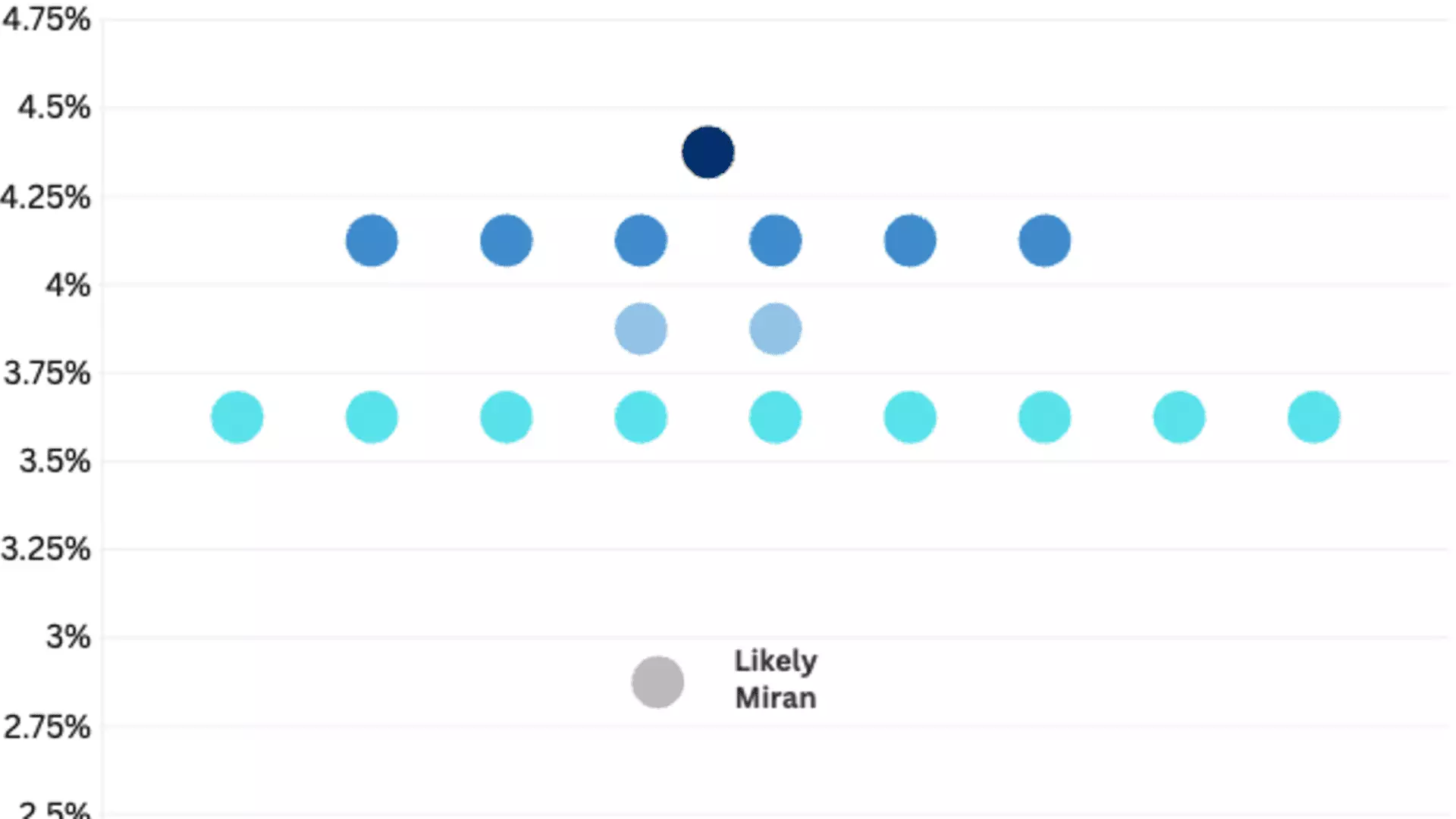
In the recent Federal Reserve decision to lower interest rates by a modest quarter-point, the spotlight unexpectedly shifted to Federal Reserve Governor Stephen Miran, whose dissenting voice called for a more aggressive half-point cut. This lone stance underscores deeper issues within the central bank’s conventional consensus-driven approach, revealing cracks that could signal a shift, or perhaps an internal conflict, regarding the future direction of U.S. monetary policy. Miran’s opposition is not merely a footnote; it becomes a case study in how individual perspectives within established institutions can challenge prevailing orthodoxy, especially when influenced by political pressures and economic uncertainties. His push for a larger cut exposes the underlying tension between cautious stability and aggressive stimulus, raising questions about whether the Fed is genuinely independent or being subtly influenced by external actors.
Political Undercurrents and the Central Bank’s Independence
Miran’s appointment itself, by a president with clear political aspirations—former President Trump—raises eyebrows. With critics arguing that Trump’s nominations aim to erode the Fed’s independence, Miran’s advocacy for a more drastic rate cut appears to fit within a broader strategy of political influence over monetary policy. While the Fed claims to operate independently, the reality is often more nuanced: appointments, public statements, and dissent signals matter. Miran’s stance, advocating for a rate reduction twice as large as the consensus, aligns with the president’s earlier calls for even lower rates. This dynamic poses a risky game: should monetary policy bend to political desires, the inflationary and economic stability risks could become magnified. The Fed’s traditional role as an anchor of stability might be compromised if dissenters like Miran push beyond prudence, blending policy debates with partisan signals.
Implications of Dissent: Is the Fed Losing Its Cohesion?
The dividing lines within the Federal Open Market Committee are becoming increasingly evident. Miran’s dissent highlights a growing polarization among policymakers: some favor measured, gradual adjustments, while others see the need for decisive action. This fragmentation can be interpreted as a sign of a central bank struggling to maintain cohesion amid external pressures and an uncertain economic outlook. Such internal conflicts threaten not only strategic clarity but also market confidence. When individual members openly challenge the consensus, it raises concerns about the stability of the policy framework and the credibility of the Fed’s communication. Miran’s call for a double-sized rate cut hints at a more dovish future, yet it may also be a signal that the central bank is internally divided—an unsettling prospect for investors and consumers aiming for steady economic signals.
The Broader Context: Monetary Policy in a Politicized Environment
This internal discord occurs against a backdrop of a presidential administration eager to influence monetary policy. President Trump’s explicit calls for a significantly lower rate and his ongoing conflicts with Fed independence suggest an uneasy tug-of-war. Miran’s position, coupled with his political appointment, could be viewed as a pawn in this larger game—an attempt by political interest groups to sway economic policy. On one hand, lower rates can boost economic growth and asset prices; on the other, they risk fueling inflation and creating asset bubbles. The danger lies in abandoning the principle of independent monetary policy in favor of short-term political wins, which could ultimately undermine long-term economic stability.
The Future of the Fed: Will Dissenters Reshape the Central Bank?
If Miran’s vocal opposition gains traction, it could catalyze a more turbulent era for the Fed. Traditionally, the institution thrives on consensus, aligning its actions with data and economic realities rather than political pressures. Yet, the current environment suggests that dissenters might increasingly question the prudence of incremental rate hikes or cuts, advocating for a more aggressive approach. This shift could lead to a more volatile monetary policy landscape—one where markets must constantly interpret signs of internal disagreement. For center-right advocates concerned with maintaining a balanced approach to inflation and employment, Miran’s stance is both a warning and a potential promise: that the Fed may be at a tipping point, no longer just a technocratic institution but one caught in the crossfire of political influence and internal division. Whether this will lead to more robust debate or undermine the Fed’s credibility remains to be seen, but it certainly exposes the fragility of its perceived independence.