
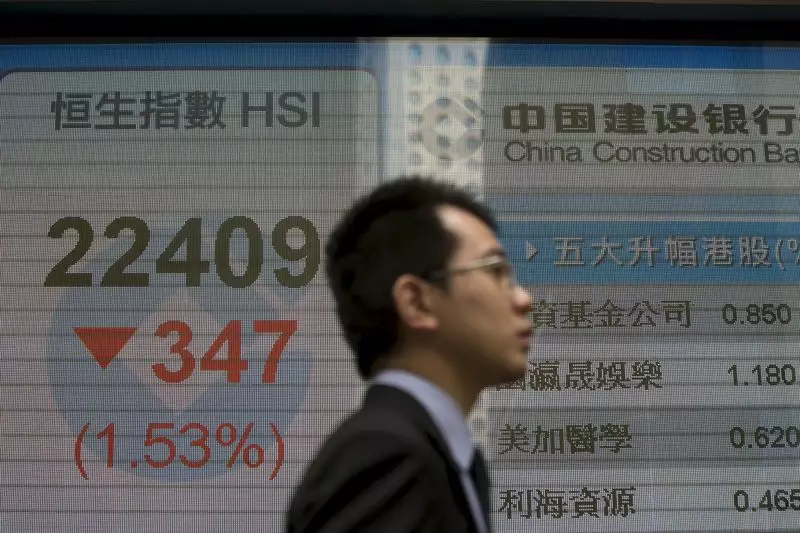
Asian stock markets experienced a downturn on Tuesday, primarily driven by prevailing uncertainties surrounding U.S. interest rates and the impending presidential election. As traders adopt a more risk-averse stance, regional markets largely reflected the setbacks seen on Wall Street, where U.S. stock indices pulled back from their recent record levels. Traders are apprehensive about rising Treasury yields, which could influence investment strategies, especially as the earnings season for U.S. companies approaches.
The U.S. presidential election, less than two weeks away, is becoming the focal point for traders. Polls indicate a tightening race, particularly favoring Republican nominee Donald Trump against Vice President Kamala Harris, adding to the uncertainty driving the market sentiment.
Across Asia, numerous stock indices faced declines. Japan’s Nikkei 225 index registered a significant drop of 1.7%, while the broader TOPIX index declined by 1.1%. This downturn persisted despite the Japanese yen hitting its weakest point in nearly three months, which would typically offer a competitive edge to export-driven companies. The volatility in the yen is largely attributed to questions surrounding the Bank of Japan’s potential interest rate adjustments.
The upcoming general elections in Japan and a crucial Bank of Japan meeting at the end of the month will likely contribute to market fluctuations. Traders are particularly keen on forthcoming inflation data from Tokyo, which could significantly impact future interest rate predictions.
Meanwhile, South Korea’s KOSPI index dipped over 1%, and Australia’s ASX 200 saw a larger retreat of 1.4%. The Australian market experienced heavy profit-taking after reaching record heights earlier in the month, illustrating the ongoing anxiety among investors. Moreover, initial indicators from India’s Nifty 50 suggested a tepid opening, as profit-taking continued despite previous upward movements.
In stark contrast to their regional counterparts, Chinese markets emerged as the solitary beacon of positive movement. The Shanghai Shenzhen CSI 300 and the Shanghai Composite indices posted gains ranging between 0.2% and 0.3%, while Hong Kong’s Hang Seng index edged up by 0.4%. The recent optimism in Chinese stocks can be attributed primarily to a larger-than-anticipated cut to the benchmark loan prime rate enacted by the People’s Bank of China. This monetary easing effort aligns with a series of stimulus measures recently rolled out by Beijing, aimed at rejuvenating economic growth.
As policymakers work to stabilize the economy, market participants are keenly observing the conditions and outcomes of these measures. The overall sentiment reflects the intricate balancing act between stimulating economic growth and managing inflationary pressures.
While Asian markets faced considerable challenges stemming from external uncertainties, particularly from the U.S., some sectors such as China’s showcased resilience, reinforcing the ongoing narrative of divergent market conditions across the region. Investors continue to navigate a complex landscape as they await critical economic data and political outcomes ahead.