
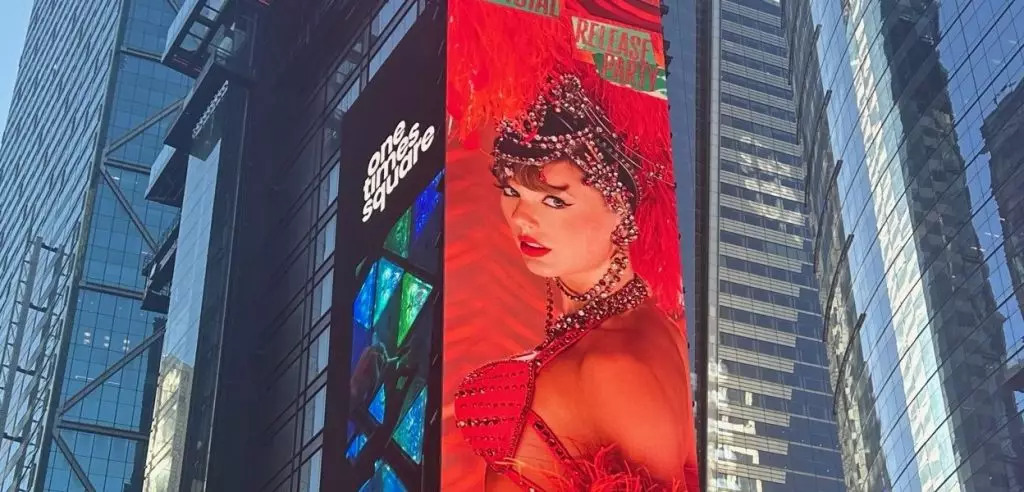
In a daring move that starkly contrasts with traditional Hollywood distribution, Taylor Swift’s “The Official Release Party of a Showgirl” showcases a willingness to challenge the entrenched studio system. By bypassing the major studios and partnering directly with AMC, Swift’s team is not merely seeking a profit but rewriting the very rules of the cinematic economy. The initial presales alone—racking up $15 million within 24 hours—highlight an audience eager to consume content on her terms, hinting at a shift from passive studio-led releases to artist-centered strategic control.
This calculated risk creates an intriguing dynamic: Swift’s team prioritizes total control over her content’s profitability and distribution. Unlike her previous Eras Tour film, which enjoyed extensive marketing campaigns and opened with nearly $93 million domestically, “Showgirl” relies on a minimalist promotional approach, with no trailers and modest ticket prices ($12). This minimalist strategy isn’t a sign of weakness but a deliberate effort to maximize margins while maintaining an element of mystique—a departure from the over-hyped, overspent campaigns that have become the norm. Her direct approach evidences a broader shift in cultural power, where artists exploit emerging digital landscapes to bypass the diluting influence of Hollywood’s traditional gatekeepers.
The Financial Reckoning with Hollywood’s Flawed Business Model
The conventional model—big-budget studios pouring hundreds of millions into marketing, then hoping for blockbuster returns—has long been under scrutiny for its inefficiencies. Swift’s move underscores a crucial critique: Hollywood’s reliance on mega-studios and their multi-layered distribution channels is increasingly obsolete. By self-funding and controlling her film’s distribution, she sidesteps the inflated P&A (prints and advertising) costs that typically eat into profits, which for her “Eras Tour” was around $55 million globally. Instead, “Showgirl” is expected to operate with significantly smaller promotional investments, demonstrating a smarter, leaner approach.
Furthermore, her strategic ticket pricing emphasizes her understanding of the modern consumer. The modest $12-$20 ticket prices cater to her massive fanbase, many of whom are priced out of traditional theatrical experiences. Her move is not about chasing record-breaking box office numbers but about creating a profitable niche and reinforcing her brand’s cultural relevance. This approach resonates with a broader, center-right wing liberal idea: fostering market efficiency and empowering artists rather than enriching conglomerates.
Disrupting Predicted Outcomes: Who Truly Controls the Audience?
Industry insiders have long predicted the end of traditional theatrical hits, but Swift’s “Showgirl” challenges this narrative profoundly. The film’s anticipated opening scores—anywhere from $30 million to $50 million over its limited run—may seem modest compared to her previous blockbuster, but the message is clear: artists are no longer beholden to Hollywood’s box office ambitions. This release underscores how the consumer value chain is shifting, favoring direct artist-to-fan relationships and innovative distribution models.
Moreover, the timing and scarcity of “Showgirl,” dropping on a single weekend without extensive trailers, serve as a powerful marketing tactic. It creates a buzz fueled by exclusivity, elevating the event from a cinematic release to a cultural phenomenon. This model could force traditional studios to reassess their dependence on expensive global campaigns that often fail to generate the expected ROI. Swift’s success—already the sixth highest presale day for AMC—serves as striking proof that a new paradigm is emerging: one where artists wield more power to dictate their content’s financial and cultural destiny.
The Future of Hollywood: A More Democratic Era?
If “Showgirl” proves anything, it’s that Hollywood’s outdated one-size-fits-all approach is nearing saturation point. Swift’s innovative distribution model exemplifies the possibilities when artists and exhibitors collaboratively sidestep the middlemen, sharing profits more equitably and engaging fans directly. The current landscape is ripe for a democratization of media, fueled by digital savvy, strategic partnerships, and a keen understanding of audience behavior.
This shift also hints at a broader cultural change—one where art is less about commercial overreach and more about authentic engagement. Swift’s refusal to overspend on promotion and her focus on the core fan experience reflect a pragmatic realism missing in many Hollywood giants. As more artists follow suit, the Hollywood model of blockbuster dominance will face increasing challenges from entrepreneurs who prioritize control, efficiency, and authenticity over blind spectacle.
While the film industry faces an uncertain future, it is clear that the old model is fraying at the edges. Artists like Swift prove that reinvention is not only possible but necessary to thrive in a rapidly evolving entertainment landscape. This is the dawn of a new era—less centralized, more artist-driven, with consumers wielding greater power than ever before.